About International Standard Serial Number (ISSN)
Royal Danish Library assigns ISSN numbers to periodicals, such as journals, newsletters, newspapers and yearbooks in both printed and electronic form.
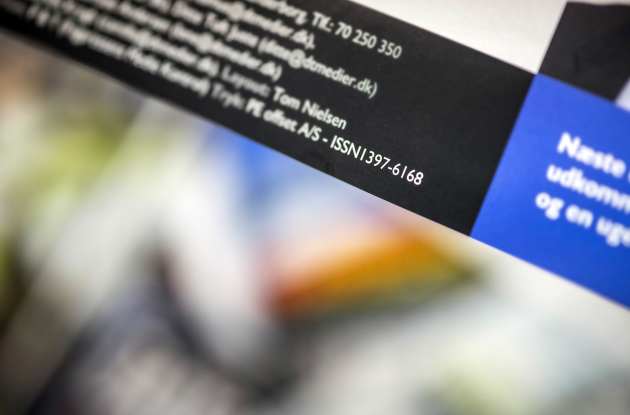
Photo: Thomas Søndergaard
ISSN (International Standard Serial Number) is an international numbering system used to identify serial publications issued on a regular basis, such as newspapers, magazines, journals and blogs, in both print and electronic formats. These publications are referred to as periodicals.
Royal Danish Library assigns ISSN numbers to periodicals. You can contact us to request an ISSN for your journal. On this page, you will find the application form along with practical information about ISSN.
The benefits of ISSN
- ISSN identifies any title in any language, anywhere in the world. Each periodical is assigned an individual and immutable number according to international standard. One ISSN represents one title. One thus avoids confusion with other titles.
- ISSN is used by libraries, booksellers and others to identify titles, to order and claim periodicals.
- ISSN can simplify interurban loans and can be used in the work with joint catalogues.
- Searching ISSN in databases provides fast title retrieval.
- An ISSN that has been used once can never be assigned to another periodical.
Which publications are awarded an ISSN?
As the definition of a periodical is very broad, each national centre can set its own criteria the types of publications allocated an ISSN.
ISSN Denmark assigns ISSNs to significant periodicals in any medium, which are issued in successive parts, identified by numeral, alphabetical and/or chronological designations, and intended to continue indefinitely.
Periodicals include, for example, newspapers, periodicals and annual publications (including certain publications that are regularly issued in new editions).
How to get a ISSN?
If you do not already have an ISSN, please contact Royal Danish Library via the application form. If your journal has already been published, you can upload a copy of the journal’s title page and colophon (publisher information) using the form below. We will then assign an ISSN. If the title of your journal changes, a new ISSN must be assigned, and the barcode must therefore also be updated.
Key title
Every periodical has a key title. It is usually the title as it appears on the title page that forms the basis of the key title.
If the title consists only of generic terms such as report, yearbook, writings or newsletter, or if it is identical to the title of another publication, additional qualifiers must be added, such as the publisher’s name or place of publication, in order to distinguish between the titles.
In other cases, qualifiers such as (Online) or (English edition) must be added to distinguish between two or more editions with the same title.
Supplements are assigned their own ISSN if they have separate numbering, as are parallel versions of periodicals published in different languages.
The ISSN is inextricably linked to the key title; therefore, a periodical that changes its title must be assigned a new ISSN.